



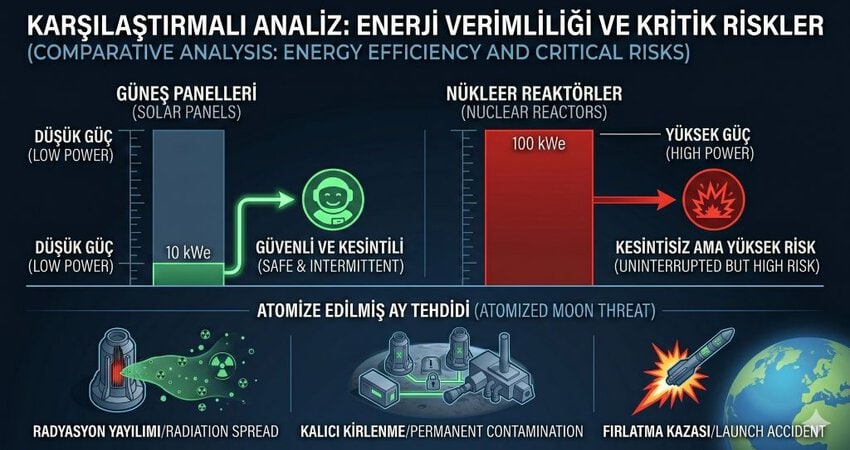
The White House and NASA have unveiled a roadmap to deploy operational nuclear reactors on the lunar surface and in orbit by 2030.
*Murat Yeşil
American News Agency (ANA)
News Summary
The White House and NASA have unveiled a roadmap to deploy operational nuclear reactors on the lunar surface and in orbit by 2030. Framed as a cornerstone of “US Space Superiority,” the initiative aims to provide continuous power for deep-space missions where solar energy falls short. However, the military potential and the prospect of turning the Moon into a nuclear hub are sparking global security concerns, interpreted by some as a quest for “Lunar-based global control” and a new era of geopolitical tension.
1: What is the exact technical and strategic goal of this NASA project?

- NASA’s official narrative focuses on “uninterrupted energy” for a permanent human presence on the Moon and eventual Mars missions.
- Current solar panels are insufficient during lunar nights or in deep craters.
- The new guidelines released by the OSTP state that nuclear fission reactors will provide electricity for lunar bases and enable nuclear electric propulsion for spacecraft to carry heavier payloads across vast distances.
- However, the emphasis on “US Space Superiority” within the memorandum suggests that the project is as much about strategic dominance as it is about scientific discovery.
2: The “Atomized Moon” Threat: What are the technical risks and the feasibility of this project?
- Technically, placing a reactor in orbit by 2028 and on the lunar surface by 2030 is an extremely aggressive timeline.
- The project, involving the Pentagon and the DOE, aims to develop modular and scalable reactors (20-100 kWe).
- The risk lies in the “Atomized Moon” scenario. The lack of a lunar atmosphere means any nuclear leakage or accident would spread radiation across the entire surface and surrounding orbit. The lunar ecosystem could be irreversibly damaged.
- Furthermore, an accident during the launch of nuclear fuel (uranium) from Earth could expose our own atmosphere to a radioactive catastrophe.
3: The Obsession with “Controlling Earth from the Moon”: Is this project a global security threat?
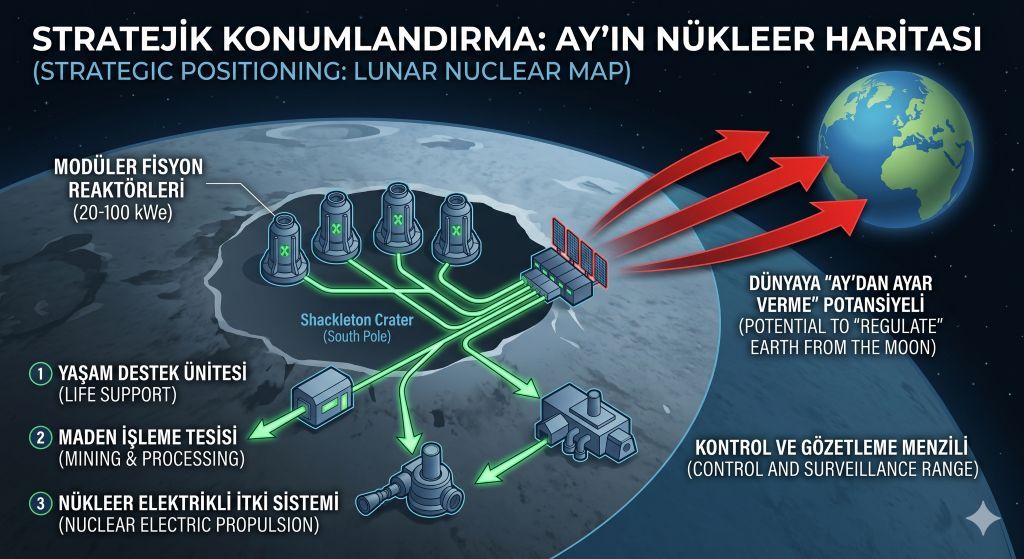
- Critics view this move not as an innocent energy project, but as part of an obsession with “Controlling Earth from the Moon.”
- Militarily, the Moon is the ultimate “high ground.” Nuclear-powered laser systems or advanced surveillance tools stationed on the Moon could target any point on Earth.
- This is being characterized as a “Madness of Nuclearizing the Moon,” violating the spirit of the 1967 Outer Space Treaty.
- Nuclear-powered satellites could serve as energy sources for weapon platforms capable of disabling rival nations’ space assets.
4: What reaction is expected from the world? Where will international objections converge?
- Reactions will likely converge on three fronts: the militarization of space, environmental safety, and international law.
- Rivals like China and Russia will perceive this move as a trigger for a new arms race. With China also seeking advanced energy capabilities, the Moon could become a new “Cold War” front.
- Developing nations will oppose the attempt to “Regulate Earth from the Moon,” asserting that the Moon is the “common heritage of mankind” and demanding international oversight on nuclear waste management and safety protocols.
5: Is the US aiming for unipolar space hegemony through this project?
- Statements from Jared Isaacman and the OSTP highlight the “US flag” and “US superiority.”
- This reflects a desire to monopolize space infrastructure beyond mere technological competition.
- Nuclear power will grant the US operational ranges and power capacities that its rivals cannot match.
- If this “Lunar Nuclearization” plan succeeds, the US could seize control of lunar resources (e.g., Helium-3), architecting the energy and security landscape of the next century from the Moon.
Author: *Murat Yeşil, Ph. D.
Professor of Journalism & Media Studies
Managing Editor
American News Agency (ANA)
References
- WIRED: “NASA Wants to Put Nuclear Reactors on the Moon” (2024).
- White House OSTP: “Memorandum on National Strategy for Space Nuclear Power and Propulsion.”
- NASA: “Artemis Program: Fission Surface Power Project Overview.”
- Outer Space Treaty (1967): United Nations Office for Outer Space Affairs.
- World Nuclear News